Best flowers for Thames Ditton High Street wedding bouquets
Posted on 18/09/2026
Choosing the Best flowers for Thames Ditton High Street wedding bouquets is one of those decisions that looks simple until you're actually doing it. Then suddenly you're weighing colour palettes, seasonality, budget, weather, venue style, and whether the bouquet will still look fresh after a long morning of photos and hugs. That's normal. A wedding bouquet has to do a lot more than just look pretty in one picture. It needs to suit the dress, the setting, the season, and the feeling you want to carry through the day.
Thames Ditton has its own character too. The High Street feel is relaxed but polished, with that local, village-neighbourhood mix that suits bouquets with a natural elegance rather than anything too stiff or overly formal. In this guide, we'll look at the flowers that work best, why they suit wedding bouquets, how to choose them confidently, and how to avoid the common mistakes that can make a bouquet feel slightly off. If you want something timeless, seasonal, and genuinely beautiful, you're in the right place.
Table of Contents
- Why Best flowers for Thames Ditton High Street wedding bouquets Matters
- How Best flowers for Thames Ditton High Street wedding bouquets Works
- Key Benefits and Practical Advantages
- Who This Is For and When It Makes Sense
- Step-by-Step Guidance
- Expert Tips for Better Results
- Common Mistakes to Avoid
- Tools, Resources and Recommendations
- Law, Compliance, Standards, or Best Practice
- Options, Methods, or Comparison Table
- Case Study or Real-World Example
- Practical Checklist
- Conclusion
- Frequently Asked Questions
Why Best flowers for Thames Ditton High Street wedding bouquets Matters
The flowers you choose for a wedding bouquet shape the whole visual tone of the day. They sit in nearly every meaningful photo, they're held during the vows, and they often become one of the few details people remember vividly later. That makes bouquet choice a lot more important than many couples expect. It's not just a floral accessory; it's part of the story.
For Thames Ditton High Street weddings, that matters even more because local couples often want something elegant but not overworked. You may be planning a church service, a civil ceremony, a small intimate gathering, or a reception with a soft classic feel. Each of those settings benefits from different flowers, but the underlying goal stays the same: balance beauty, reliability, and emotional fit.
Truth be told, a bouquet can look magnificent in a florist's fridge and still be wrong for your day if the flower choice doesn't suit the season or your theme. Roses may feel right for a romantic, traditional look; peonies bring softness and fullness, but only when they're available; lisianthus gives a gentle, refined finish; and hydrangeas can create volume quickly, though they need careful handling in warm weather. The best bouquet is the one that looks like it belongs to your wedding, not just to a flower catalogue.
That's why people searching for the best wedding bouquet flowers around Thames Ditton often need more than a pretty shortlist. They need guidance on texture, durability, scent, colour, and how the bouquet will behave during a busy wedding day. Not glamorous maybe, but very real.
How Best flowers for Thames Ditton High Street wedding bouquets Works
Picking bouquet flowers is really a matching exercise. You're matching the flowers to the season, the venue, the outfit, the mood, and your practical limits. Start there, and the rest becomes much easier. A bouquet that suits a spring registry ceremony might feel too heavy for a summer marquee reception, while a minimalist bouquet can look beautifully modern in one setting and a little underdressed in another. Funny how that works.
In practice, the process usually looks like this:
- Choose the overall style. Soft and romantic? Clean and modern? Garden-inspired? Traditional?
- Match the colour palette. White, blush, ivory, and green remain popular for wedding bouquets, but there's room for lilac, peach, yellow, and deeper berry tones too.
- Check seasonal availability. Seasonal flowers usually offer better value, better freshness, and a more natural look.
- Balance shape and size. A round posy feels different from a loose hand-tied bouquet or a cascading arrangement.
- Think about durability. Some blooms handle heat, transport, and holding time better than others.
For local wedding bouquets in Thames Ditton, that last point is easy to overlook. You may collect flowers before the ceremony, travel between locations, or spend quite a bit of time outdoors for photos near the river or along the High Street. If you're standing in sunlight, bouquet choice matters more than you'd think. A flower with delicate petals can start to show stress surprisingly quickly, especially on a warm day.
Some couples choose by favourite flower first, and that's fine. But the strongest bouquets usually come from a mix of preference and practicality. A good florist can help you refine the selection without stripping away the feeling you want. If you're planning a broader floral scheme too, it can be useful to look at wedding flowers in Thames Ditton alongside the bouquet itself so the ceremony and reception feel joined up.
Key Benefits and Practical Advantages
The best bouquet flowers do more than look lovely for a few minutes. They solve problems. They hold shape, match the dress, suit the season, and photograph well in natural light. That may sound a bit practical for such a romantic thing, but wedding planning tends to be like that. Romance plus logistics. There's no escaping it.
- Better photo quality: Flowers with strong natural shape and balanced colour read well on camera.
- More reliable freshness: Durable blooms are less likely to wilt or bruise during the day.
- Stronger style coherence: The bouquet can echo the venue, dress fabric, and table flowers.
- Better value: Seasonal flowers often stretch a budget further without looking basic.
- Less stress: The right flowers need less fuss and are easier to transport and hold.
There's also a psychological benefit that people don't always mention. When your bouquet feels right in your hand, you tend to relax into the day a little more. You notice the texture of the ribbon, the smell of the stems, the small shift in the petals when you move. It grounds you. That matters, especially if you're nervous.
From a design standpoint, the right flowers can also make a bouquet feel expensive without being excessive. For example, white roses paired with lisianthus and a little eucalyptus-style greenery can feel calm and refined. Add orchids, and the whole look shifts towards polished luxury. Switch to carnations and germini in the right palette, and you can get a brighter, more playful effect. Same purpose. Different mood.
Who This Is For and When It Makes Sense
This guide is for couples who want their wedding bouquet to feel intentional, local, and suited to the day rather than just copied from a trend board. It's especially useful if you're getting married near Thames Ditton High Street and want flowers that feel elegant without being overdesigned.
It also makes sense if any of the following apply:
- You want a bouquet that fits a classic Surrey wedding setting.
- You're comparing seasonal flowers and trying to avoid last-minute substitutions.
- You need bouquet ideas that work with bridesmaid flowers, buttonholes, or table arrangements.
- You want a wedding look that feels soft, romantic, and not too formal.
- You're planning around a budget and need flowers that still look polished.
If you already know you want a full coordinated floral scheme, exploring matching pieces such as bridal bouquets, bridesmaid bouquets, and buttonholes can help you build a visual thread across the day. That little bit of consistency goes a long way in photographs. No need to match everything exactly, by the way. That would be a bit much.
It makes sense too for people who are not floral experts and simply want reliable guidance. You do not need to know the Latin names or the difference between a spray rose and a garden rose to make a good choice. You just need to know what feels right, what lasts, and what works with your setting.
Step-by-Step Guidance
If you're choosing wedding bouquet flowers from scratch, this is the simplest way to approach it without getting lost in the options.
- Start with your venue and dress. A minimalist bouquet works beautifully with a sleek dress and contemporary venue, while a more layered bouquet suits lace, soft fabrics, or a garden-style setting.
- Pick your main flower. Roses, peonies, orchids, lilies, tulips, and lisianthus are all strong contenders depending on season and style.
- Add supporting flowers. Think of these as the quiet heroes: alstroemeria, carnations, germini, chrysanthemums, and hydrangeas can add shape and fullness.
- Choose foliage carefully. Greenery can soften the bouquet, but too much can make it feel heavy. You want framing, not a hedge. A small joke, but true.
- Consider the bouquet shape. Round, hand-tied, shower, and cascading designs all create a different impression.
- Review the practical details. Ask how long the flowers should last, how they are conditioned, and what happens if a specific bloom is unavailable.
- Check the finish. Ribbon, wrapping, and stem length matter more than people think. The finish can make even a simple bouquet feel elegant.
A useful rule of thumb: let one or two flowers lead, then support them with quieter companions. For example, roses and lisianthus make a soft, romantic pairing; orchids and roses feel more luxurious; tulips and white blooms give a fresh spring look; hydrangeas and roses create volume with a graceful, rounded silhouette.
If you're unsure where to begin, a florist-style starting point is often a curated bouquet collection or a florist-choice option, then refining from there. For local browsing, the weddings collection can be a good place to compare bouquet styles before deciding on the exact flowers.
Expert Tips for Better Results
Here's where the small details make a proper difference. You can have beautiful flowers and still end up with a bouquet that feels slightly too tight, too loose, too heavy, or too plain. The best results come from a few practical habits.
- Choose flowers with different shapes. Round blooms, layered petals, and slender accents create depth.
- Keep colour tones close together. Soft whites, blush, ivory, and pale green feel elegant. High contrast can work, but only if it is deliberate.
- Don't ignore scent. Some flowers smell gorgeous, some are subtle, and some can be overwhelming in a small room. You want pleasant, not perfumery-shop levels of drama.
- Ask about stem conditioning. Proper hydration and trimming can make a noticeable difference to freshness.
- Match bouquet size to the bride's frame and dress volume. A very large bouquet can overpower a delicate dress, while a tiny bouquet can disappear in photos.
- Think about heat and travel. If you're moving around Thames Ditton and taking pictures before the ceremony, choose sturdier blooms.
One thing we often notice is that couples focus heavily on the bouquet's front view. Fair enough, that's what they'll hold facing the camera. But the side view and the back finish matter too. A well-made bouquet should look lovely from several angles, because you will turn, walk, greet guests, and maybe even twist it a little without meaning to.
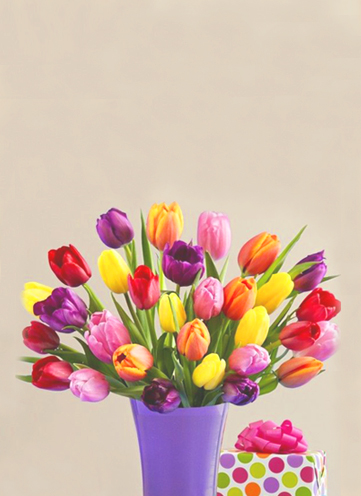
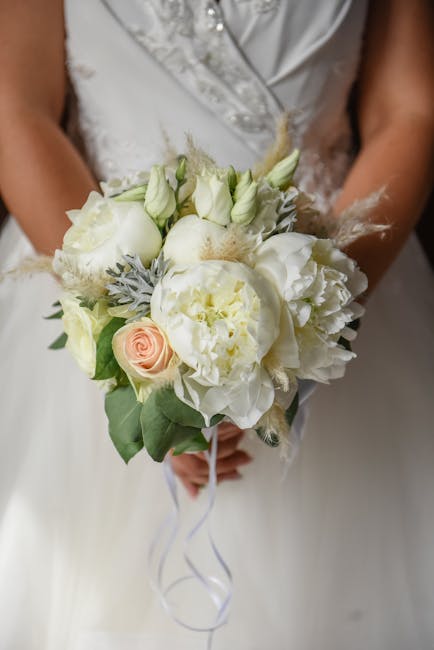
If you want a cleaner, more modern look, a bouquet built around white roses, white lilies, or orchids can be very effective. If you prefer something softer and more romantic, a mix of blush roses, lisianthus, and subtle greenery usually hits the sweet spot. And if you want a joyful spring-summer feel, tulips, hydrangeas, and yellow or mixed-colour accents can lift the whole palette.
Common Mistakes to Avoid
Weddings are emotional, and flower choices often happen in the middle of a hundred other decisions. That's how mistakes slip in. Nothing dramatic, usually, just small misjudgements that show up later.
- Choosing flowers only by photo. A bloom can look wonderful online and still be awkward for your season or venue.
- Ignoring the weather. Some flowers cope better with warmth and handling than others.
- Overstuffing the bouquet. More flowers do not always mean better design. Sometimes the shape gets muddy.
- Forgetting the dress details. A bouquet should complement neckline, fabric, and silhouette.
- Using too many strong colours. Unless you want a vivid statement bouquet, a calmer palette is usually safer for weddings.
- Leaving the decision too late. Seasonal flowers and specific varieties may not be available at the last minute.
A smaller but common issue is not thinking about the bouquet's hold time. If the ceremony is later in the day, with photographs beforehand and a reception afterwards, the bouquet needs to stay presentable for hours. That's where roses, orchids, lisianthus, and carefully conditioned seasonal blooms often outperform more delicate choices.
Another one: trying to make the bouquet do everything. If you want it romantic, modern, statement-making, and budget-friendly all at once, well, that's a lot to ask from one bunch of flowers. Better to prioritise the two or three qualities that matter most to you.
Tools, Resources and Recommendations
You do not need a complicated toolkit to make smart bouquet decisions, but a few simple resources help a great deal. The most useful thing is a clear visual reference, plus a short list of priorities.
- Colour swatches: Bring fabric or dress samples if possible. Photos on a phone can be misleading in daylight.
- Seasonal reference: Note which flowers are usually available around your wedding date.
- Style images: Save examples of bouquet shapes you actually like, not just flowers you vaguely recognise.
- Venue photos: If you have them, use them to judge whether the bouquet should feel airy, formal, rustic, or contemporary.
- Budget range: Decide whether the bouquet is the priority piece or one part of a broader floral spend.
For planning and support, pages such as flower care guidance can help you understand how to keep wedding flowers looking their best before the ceremony. If you are coordinating a delivery timeline, the delivery information is also useful, especially when timing matters and it nearly always does on a wedding morning.
If you're comparing bouquet styles, it can help to browse options like a classic bridal bouquet design, a refined matching bouquet, or a clean white bridal bouquet. Those kinds of references make it easier to judge shape and feel before choosing the final flowers.
Law, Compliance, Standards, or Best Practice
For wedding flowers, there is usually no complex legal framework specific to bouquet design itself. Still, good practice matters. Florists should handle flowers hygienically, provide clear product descriptions, and be transparent about substitutions if a stem becomes unavailable. That is standard, sensible service rather than anything dramatic.
If you are ordering for a wedding in the UK, especially with a timed delivery, a few things are worth checking carefully:
- Availability and substitution policy: seasonal flowers can change quickly, so clarity here avoids disappointment.
- Delivery expectations: confirm timing, access details, and where the flowers should be left if nobody is immediately available.
- Refund or issue handling: understand what happens if an order arrives damaged or incomplete.
- Accessibility and communication: if you need specific arrangements for collection or delivery, say so early.
It is also good practice to work with a florist who is careful about sustainable sourcing where possible, since many couples care about reducing waste and choosing flowers that are in season. Not every bloom can be sourced locally or seasonally all year round, of course, but thoughtful selection often helps. If that matters to you, the sustainability information gives a helpful sense of the approach behind the flowers.
On the practical side, always confirm the bouquet has been conditioned properly and that any ribbons, pins, or accessories will not stain the dress. Small thing, big headache if missed.
Options, Methods, or Comparison Table
Different wedding bouquet flowers suit different styles, budgets, and practical needs. The table below gives a quick comparison to help narrow things down.
| Flower type | Best for | Strengths | Watch-outs |
|---|---|---|---|
| Roses | Classic romantic bouquets | Timeless, versatile, widely available | Can feel ordinary if not styled well |
| Peonies | Soft, luxurious spring looks | Full, elegant, very wedding-friendly | Seasonal availability can be limited |
| Lisianthus | Refined, delicate arrangements | Graceful, lightweight, lovely texture | Needs careful handling for best appearance |
| Hydrangeas | Full, rounded bouquets | Creates volume quickly, soft visual impact | Can be sensitive in warm conditions |
| Orchids | Modern, elegant, polished weddings | Distinctive shape, luxurious feel | Style needs a steady hand so it does not look sparse |
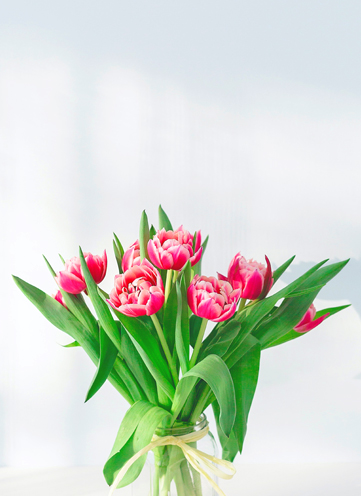
| Tulips | Fresh spring bouquets | Light, modern, clean lines | Can continue opening and shifting shape |
| Lilies | Statement bouquets with presence | Strong visual impact and elegance | Scent may be strong for some couples |
| Carnations and germini | Budget-conscious or bright bouquets | Good value, durable, adaptable colours | Need clever styling to avoid a dated look |
If you want a simple direction, here it is: roses and lisianthus are the safest all-rounder pair; peonies are ideal when in season; orchids suit a cleaner luxury look; and tulips are excellent for a modern spring bouquet. Hydrangeas are wonderful for fullness, but handle them with care. Always.
Case Study or Real-World Example
Here's a realistic example from the kind of wedding brief that comes up quite often. A couple planning a Thames Ditton High Street ceremony wanted a bouquet that felt soft, classic, and not too formal. The bride liked white roses but didn't want anything rigid or overly neat. The dress had a gentle shape, the venue was intimate, and the photos were going to be taken outdoors as well as indoors.
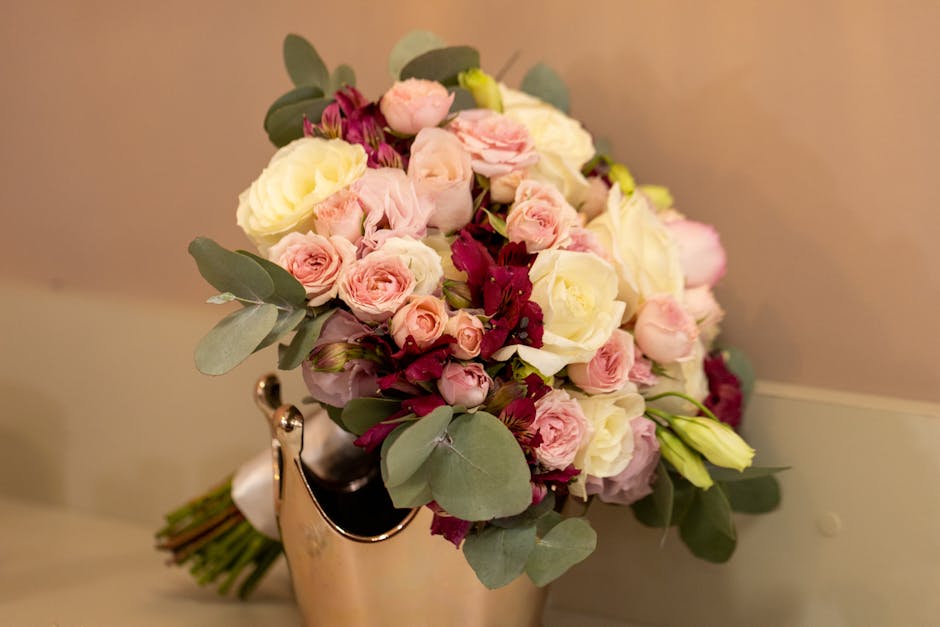
After talking through the options, the bouquet was built around white roses, pale lisianthus, and light greenery, with just a little texture from small supporting blooms. The result was calm and elegant without looking stiff. It held its shape through the day and worked well in close-up shots because the flowers had enough contrast without becoming busy. Nothing flashy. Just quietly beautiful, which in fairness is often what people really want.
What made it work?
- The flowers matched the dress rather than competing with it.
- The colour palette stayed soft, so the bouquet felt timeless.
- The design had enough structure to photograph well.
- The bloom choice suited the likely handling and timing of the day.
That's the kind of result many Thames Ditton couples are after: not the loudest bouquet in the room, just the one that feels right when you hold it.
Practical Checklist
Use this before you finalise your wedding bouquet flowers.
- Have I chosen a bouquet style that suits the venue and dress?
- Do the flowers work for the season and likely weather?
- Have I chosen a clear colour palette?
- Will the bouquet hold up through photos and travel?
- Do I want fragrance, or should it be kept subtle?
- Have I checked whether any favourite flowers are seasonal?
- Do I need matching bridesmaid bouquets or buttonholes?
- Have I asked about substitutions if a flower becomes unavailable?
- Does the bouquet size suit the dress and my frame?
- Have I confirmed delivery or collection timing?
If you can tick most of those off, you are in very good shape. The rest is refinement, and that part is usually the fun bit.
Get a free quote today and see how much you can save.
Conclusion
The best wedding bouquet flowers for Thames Ditton High Street are the ones that balance beauty, seasonality, practicality, and personal style. Roses, lisianthus, peonies, orchids, tulips, hydrangeas, lilies, and carefully chosen supporting flowers all have a place, but the smartest bouquet is rarely about one dramatic bloom. It's about how everything works together in the hand, in the photos, and in the room.
Keep the local setting in mind, keep the season in mind, and do not be afraid to choose the simpler option if it feels more like you. That usually leads to the better bouquet anyway. The one that feels calm, joyful, and quietly confident. That's the sweet spot.
And honestly, on a day as important as your wedding, you deserve flowers that make you feel steady and beautiful when you pick them up that morning.
Frequently Asked Questions
What are the best flowers for a wedding bouquet in Thames Ditton?
Roses, lisianthus, peonies, orchids, tulips, hydrangeas, and lilies are among the strongest choices. The best option depends on your wedding style, season, budget, and how long the bouquet needs to last.
Which flowers last the longest in a bridal bouquet?
Roses, orchids, lisianthus, carnations, and some chrysanthemums usually hold up well when properly conditioned. Hydrangeas can be beautiful but need more care, especially in warm weather.
Are peonies a good choice for Thames Ditton wedding bouquets?
Yes, if your wedding date aligns with peony season and you want a soft, luxurious look. They are popular for a reason, but they are not always available year-round.
What flowers look most elegant for a High Street wedding?
White roses, orchids, lisianthus, and soft mixed whites are excellent for an elegant feel. They suit classic venues and photograph beautifully without looking overdone.
How do I choose bouquet flowers that match my dress?
Look at the neckline, fabric, and silhouette of the dress. A structured dress often works with a cleaner bouquet, while lace or flowing fabrics can suit a softer, more organic arrangement.
Can I have seasonal flowers and still get a luxury look?
Absolutely. Seasonal flowers often look more natural and can offer better value. The luxury feel comes from design, finish, and flower quality, not just from rare blooms.
What if my favourite flower is not in season?
You can usually find a good visual alternative with similar shape or colour. A florist can suggest substitutes that preserve the style without forcing an out-of-season bloom.
Should the bridal bouquet match the bridesmaid bouquets exactly?
Not necessarily. It is often better for the bouquets to coordinate rather than copy each other exactly. Shared colours or flower types usually look more polished.
How far in advance should I choose my wedding bouquet flowers?
As early as possible, especially if you want a specific flower or a seasonal variety. Early planning gives you a better chance of securing the look you want and avoiding last-minute compromises.
Are roses too common for wedding bouquets?
Not at all. Roses are classic because they work. The trick is in the styling, colour choice, and supporting flowers. A well-designed rose bouquet never feels boring.
What bouquet flowers are best for a spring wedding in Thames Ditton?
Tulips, peonies, roses, ranunculus-style looks if available, lisianthus, and soft mixed whites or blush tones are all strong spring choices. They bring a fresh, light feel that suits the season well.
Do I need different flowers for the bride and bridesmaids?
It helps if the bouquets are distinct enough to give the bride's bouquet a little more presence. They should feel related, but not identical. That keeps the overall look balanced and easy on the eye.